
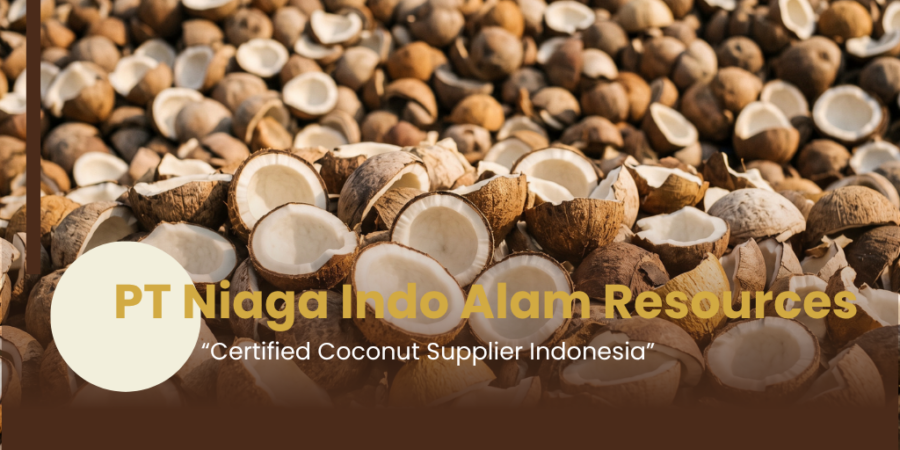
Certified Coconut Supplier Indonesia
For international buyers, choosing a coconut supplier involves more than comparing prices. Product quality, food safety, certification, processing controls, documentation, and supply reliability all matter.
PT Niaga Indo Alam Resources is an Indonesian agribusiness company based in Pasuruan, East Java. The company develops and processes coconut and kenaf commodities and supplies coconut-based products for international markets. Its product portfolio includes desiccated coconut, edible white copra, coconut meat, coconut shell, coconut shell charcoal, and cocopeat.
For buyers seeking a certified coconut supplier in Indonesia, NIA Resources now holds ISO 22000:2018, Hazard Analysis and Critical Control Point (HACCP), and Indonesian Halal certification.
These certifications provide an important foundation for buyers evaluating food safety, production controls, and supplier compliance.
Certified Coconut Supplier for Global B2B Buyers
International buyers often need more than a product catalog.
A professional supplier should be able to explain how products are processed, how food safety risks are controlled, and which certifications support the production system.
Certification is therefore an important part of supplier evaluation.
NIA Resources combines coconut processing with documented production procedures, quality control, packaging, and international-market supply. The company publishes information about its production machinery and coconut processing capabilities. Its machinery includes coconut peeling, husk removal, slicing, drying, graining, and weighing equipment.
For B2B buyers, this combination provides a better starting point for supplier qualification than a simple product listing.
Our Food Safety Certifications
NIA Resources has obtained three important certifications that strengthen its position as a certified coconut supplier.
ISO 22000:2018
ISO 22000:2018 is an international standard for food safety management systems.
For coconut products intended for food applications, a food safety management system can help an organization manage hazards across relevant stages of the food chain.
For buyers, the certification can provide an additional basis for evaluating the supplier’s food safety management approach.
NIA Resources’ ISO 22000:2018 certification should be considered together with its production procedures, quality controls, product specifications, and applicable batch documentation.
HACCP
Hazard Analysis and Critical Control Point (HACCP) is a systematic approach to identifying, evaluating, and controlling food safety hazards.
HACCP focuses on preventive controls rather than relying only on final-product inspection.
For a coconut supplier, this approach is particularly relevant to raw material handling, processing, drying, storage, and packaging.
NIA Resources’ HACCP certification strengthens the company’s food-safety credentials for buyers evaluating coconut products for food applications.
Indonesian Halal Certification
NIA Resources also holds an Indonesian Halal Certificate.
Halal certification can be especially relevant for buyers serving Muslim consumers or markets where Halal compliance is an important purchasing requirement.
The certificate also provides buyers with a documented basis for evaluating the applicable product or production scope.
Buyers should request the current certificate and confirm its scope for the specific product being purchased.
What These Certifications Mean for Buyers
Certification should not be treated as a decorative badge.
For a professional buyer, the important question is:
What does the certification mean for my purchasing risk?
There are several practical benefits to reviewing a supplier’s certifications.
Better Supplier Qualification
Certification provides additional evidence when buyers compare suppliers.
It does not replace supplier due diligence. However, it can help buyers assess whether a company has a structured food safety and quality management approach.
Food Safety Management
ISO 22000:2018 and HACCP are especially relevant to food-related coconut products.
They show that food safety management is part of the supplier’s operating framework.
Market Requirements
Different markets and customers can have different certification requirements.
A buyer may need Halal certification, food safety certification, a Certificate of Analysis, or additional documentation depending on the product and destination.
Therefore, buyers should discuss the required documentation before placing an order.
Certified Coconut Products from Indonesia
NIA Resources supplies several coconut-derived products for international buyers.
The available products include food ingredients, raw materials, agricultural products, and coconut by-products.
Desiccated Coconut
Desiccated coconut is dried coconut meat used in bakery, confectionery, snacks, and food manufacturing.
NIA Resources produces desiccated coconut in different sizes and packaging formats.
The company lists consumer packaging from 100 grams to 1,000 grams and an industrial packaging option of 25 kg multi-layer kraft sack.
For bulk buyers, the exact grade, particle size, moisture requirement, packaging, and quantity should be confirmed before ordering.
Learn more about the product on the Premium Desiccated Coconut Indonesia page.
Edible White Copra
Edible white copra is a processed coconut raw material with applications in food and non-food industries.
NIA Resources states that its edible white copra has a white appearance and approximately 6–8% moisture content.
The company lists applications including Virgin Coconut Oil production, food products, cosmetics, and pharmaceutical-related uses.
Product specifications should always be confirmed according to the buyer’s intended application.
Coconut Meat
Coconut meat is the white edible part inside the coconut shell.
It can serve as a raw material for coconut milk, desiccated coconut, coconut flour, coconut oil, snacks, and other coconut-based products.
For manufacturers, the intended application is important because specifications can differ between processing requirements.
Coconut Shell
Coconut shell is a valuable by-product of coconut processing.
It can be utilized for charcoal production, activated carbon, handicrafts, and other applications.
This helps maximize the value of coconut raw materials while reducing unused agricultural by-products.
Coconut Shell Charcoal
Coconut shell charcoal is produced from coconut shells and can be used in energy and industrial applications.
Potential applications include charcoal, briquettes, and activated carbon production.
See also NIA Resources’ Coconut Shell Charcoal Indonesia page for additional product information.
Cocopeat Block
Cocopeat is a coconut husk-based growing medium.
NIA Resources lists cocopeat blocks measuring approximately 30 × 30 × 10 cm and weighing around 5 kg.
The company positions cocopeat for horticulture, hydroponics, and soil improvement.
This product provides an agricultural use for coconut husk material.
Quality Control from Processing to Packaging
Certification is only one part of supplier qualification.
Buyers should also understand how the supplier manages its production process.
NIA Resources publishes information about its coconut processing equipment and production procedures.
The production equipment includes:
Coconut peeling machine
Husk remover
Coconut slicing machine
Dryer machine
Graining machine
Digital scales
The company states that these machines help improve work efficiency, product consistency, and processing capacity.
For copra production, NIA Resources also publishes a process covering raw material selection, peeling and splitting, drying, quality checking, cooling, storage, and packaging.
The company specifies mature, healthy coconuts without rot or mold as the starting material for its published copra procedure.
This type of documented production process helps buyers understand how quality is managed throughout processing.
Coconut Processing Capability
A certified supplier should also have the operational capability to produce the required products consistently.
NIA Resources combines coconut sourcing with processing and product development.
Its capabilities include several stages of coconut preparation and processing.
First, appropriate raw materials are selected.
Next, the coconut is prepared through peeling, splitting, or husk removal.
Depending on the product, the material can then undergo slicing, graining, drying, and other processing stages.
Finally, products are weighed, packed, stored, and prepared for the intended market.
This structured process is important for international B2B buyers because product consistency depends on more than the raw material itself.
Product Specifications and Documentation
A professional buyer should request product-specific documentation before placing an order.
Depending on the product, useful information can include:
Product specification
Grade
Moisture content
Particle size
Fat content
Color
Packaging
Shelf life
Storage requirements
Certificate of Analysis
Applicable certifications
Export documentation
NIA Resources’ certification portfolio includes ISO 22000:2018, HACCP, and Indonesian Halal certification.
However, certification status and scope should always be confirmed against the current certificate and the product being ordered.
A buyer should also ask whether a batch-specific Certificate of Analysis is available.
Bulk Coconut Supply for International Buyers
B2B buyers often require larger quantities and recurring shipments.
Therefore, the supplier’s commercial capability matters as much as the certification itself.
Before placing a bulk order, buyers should confirm:
Minimum order quantity
Available quantity
Production lead time
Packaging format
Current production availability
Shipment schedule
Incoterms
Payment terms
Required documentation
NIA Resources positions its coconut derivatives for global markets and describes its production and export preparation capabilities.
For current product availability and quotation, buyers should contact the company directly with their required quantity and specification.
Why Choose a Certified Coconut Supplier?
A certification-backed supplier can reduce uncertainty during supplier qualification.
However, certification should form part of a broader evaluation.
Food Safety
ISO 22000:2018 and HACCP provide a stronger food-safety basis for food-related supply.
Halal Compliance
The Indonesian Halal certification can support buyers who require Halal-compliant products.
Processing Capability
NIA Resources uses dedicated machinery across several coconut processing stages.
Product Range
The company supplies multiple coconut products rather than a single coconut derivative.
International Orientation
NIA Resources develops coconut products for international markets and global business relationships.
Documented Processes
The company publishes processing procedures that cover raw material selection, drying, quality checking, storage, and packaging.
Together, these factors provide buyers with a broader picture of supplier capability.
Indonesian Coconut Supplier for Global Markets
NIA Resources is located in Pasuruan, East Java, Indonesia.
The company focuses on coconut and kenaf commodities and supplies coconut derivatives for international buyers.
Its international-market positioning is relevant to buyers across several regions.
Russia
Russian importers can explore Indonesian coconut products for food, industrial, and other applications.
For Russia-specific sourcing information, see the Coconut Supplier Russia page.
Saudi Arabia and the Middle East
Halal certification can be particularly relevant for buyers serving Muslim-majority markets.
Buyers should still confirm the specific certification and documentation requirements applicable to their destination.
United Kingdom
UK buyers may require detailed food safety documentation, product specifications, and import documentation.
Product requirements should be confirmed before shipment.
Germany
German buyers may place strong emphasis on product specifications, food safety, documentation, and consistent quality.
Japan
Japanese buyers often require clear specifications and reliable quality management.
The exact requirements should be agreed with the importer before production.
China
Chinese buyers may require product-specific documentation, labeling, customs information, and other import requirements.
The buyer and importer should confirm the applicable requirements before shipment.
How to Verify a Coconut Supplier
A buyer should not rely on the word “certified” alone.
Supplier verification should involve several checks.
Check the Certificate
Ask for the certificate itself.
Verify:
Certificate name
Certificate number
Issuing body
Scope
Issue date
Expiry date
Certified site or facility
Check the Product Scope
A company may hold a certification that does not automatically cover every product.
Therefore, confirm whether the certification applies to the product being purchased.
Request Product Specifications
Ask for the technical specification before negotiating a final order.
Request a Sample
A sample allows the buyer to evaluate the actual product.
Request a Certificate of Analysis
Where applicable, ask for a COA for the relevant batch.
Review the Production Facility
Factory photographs, production machinery, processing procedures, and quality-control information can provide additional evidence.
Confirm Export Documentation
Discuss the documents required for the destination market before shipment.
This process gives buyers a more complete assessment than relying on certification logos alone.
What Should Buyers Ask a Certified Coconut Supplier?
Before placing an order, international buyers can ask:
Which products are currently available?
What product grades can you supply?
What are the technical specifications?
What is the MOQ?
What quantity can you supply regularly?
Which certifications are currently valid?
What is the scope of each certification?
Can you provide a Certificate of Analysis?
Can you provide product samples?
What packaging options are available?
What is the production lead time?
Which export documents are available?
Which Incoterms do you offer?
Which destination port can you support?
Can you support recurring orders?
These questions help buyers compare suppliers on measurable criteria.
Certified Does Not Mean One-Size-Fits-All
Certification is important, but it does not automatically mean that every product meets every buyer requirement.
For example, a food manufacturer may have very specific limits for:
Moisture
Microbiological parameters
Fat content
Particle size
Residual chemicals
Packaging
Shelf life
Another buyer may have different requirements.
Therefore, the supplier qualification process should always combine certification with product-specific specifications and documentation.
A Better Way to Source Coconut Products from Indonesia
For international buyers, a structured sourcing process can reduce risk.
Start by defining the product.
Next, define the required specification and quantity.
Then, shortlist suppliers that can provide the appropriate product and certification.
After that, request documentation and samples.
Finally, compare the commercial quotation, lead time, packaging, documentation, and supply capability.
This process helps buyers make a decision based on total supply suitability rather than price alone.
NIA Resources: Certified Coconut Supplier Indonesia
PT Niaga Indo Alam Resources combines coconut processing, multiple coconut product categories, documented production procedures, and food safety certifications.
The company’s current certification portfolio includes:
ISO 22000:2018
HACCP
Indonesian Halal Certification
These certifications strengthen the company’s credentials for buyers seeking a certified coconut supplier in Indonesia.
At the same time, buyers should review the applicable certificate scope, product specifications, and commercial conditions for each order.
NIA Resources offers a product range that includes desiccated coconut, edible white copra, coconut meat, coconut shell, coconut shell charcoal, and cocopeat.
For international buyers, the company can discuss product requirements, quantities, packaging, and export documentation directly.
Request Certified Coconut Products from Indonesia
Looking for a certified coconut supplier in Indonesia starts with the right product and the right documentation.
PT Niaga Indo Alam Resources provides coconut-based products for international buyers and supports supplier evaluation through its published product information, processing capabilities, quality procedures, and certifications.
For a quotation or product inquiry, provide:
Product required
Specification
Quantity
Packaging requirement
Intended application
Destination country
Required certification
Required documentation
Target delivery schedule
The more specific the inquiry, the easier it is to prepare a relevant commercial response.
Request a Product Quotation
PT Niaga Indo Alam Resources
Jl Raya Sidogiri, Desa/Kel. Asem Kandang, Kec. Kraton, Pasuruan, East Java, Indonesia
Phone / WhatsApp: +62 813 1323 375
Email: niagaindo.resources@gmail.com
Frequently Asked Questions
Is NIA Resources a certified coconut supplier in Indonesia?
Yes. PT Niaga Indo Alam Resources is an Indonesian coconut supplier with ISO 22000:2018, HACCP, and Indonesian Halal certification.
What certifications does NIA Resources have?
NIA Resources has ISO 22000:2018, Hazard Analysis and Critical Control Point (HACCP), and Indonesian Halal certification.
What coconut products does NIA Resources supply?
The company supplies desiccated coconut, edible white copra, coconut meat, coconut shell, coconut shell charcoal, and cocopeat.
Does certification guarantee product quality?
Certification supports a supplier’s management and compliance framework, but buyers should still check product-specific specifications, samples, COA, and applicable documentation.
Can buyers request product samples?
Yes. Buyers should contact NIA Resources with the product and specification they want to evaluate and discuss sample availability.
Can international buyers purchase coconut products in bulk?
NIA Resources positions its coconut products for international markets. Buyers should contact the company with the required product, quantity, packaging, and destination to confirm current availability and commercial terms.
Does NIA Resources offer desiccated coconut?
Yes. Desiccated coconut is one of the company’s primary coconut products. NIA Resources lists several packaging formats, including a 25 kg industrial packaging option.
Can buyers request a Certificate of Analysis?
Buyers can request applicable product documentation, including a Certificate of Analysis, according to the product and order requirements.
Is Halal certification relevant to international buyers?
Yes. Halal certification can be an important supplier requirement for buyers serving Muslim consumers and markets. The applicable certificate scope should be confirmed for the specific product.
Where is NIA Resources located?
PT Niaga Indo Alam Resources is located on Jl Raya Sidogiri, Desa/Kel. Asem Kandang, Kec. Kraton, Pasuruan, East Java, Indonesia.
How can I request a quotation?
Contact NIA Resources by phone/WhatsApp or email with your product, specification, quantity, packaging, destination, and documentation requirements.